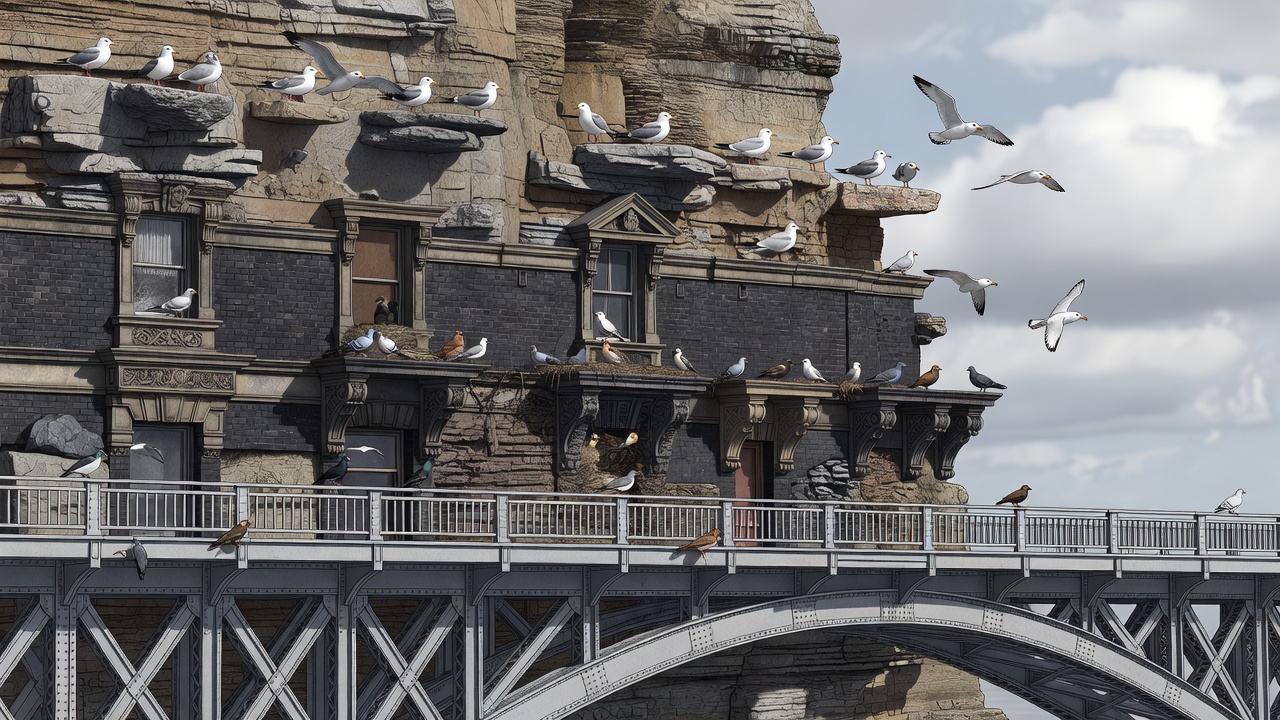
Ancestral Cliff Dwellers in Modern Plazas
Unlike songbirds that require pliable branches and leaves to weave cup nests, rock doves naturally build rudimentary twig and feather scrapings on narrow, vertical rock shelves. Modern city buildings—with decorative stonework cornices, recessed lintels, covered train viaducts, and bridge trusses—offer millions of square meters of artificial cliff nesting space.
The Urban Heat Island Effect
Cities remain several degrees warmer than surrounding countryside due to asphalt heat retention and industrial exhaust. Pigeons capitalize on this microclimate, enabling pairs in temperate cities like London, Paris, and Chicago to breed year-round, raising multiple clutches even in mid-winter months.
Thermal Ecology • Microclimate Breeding
The Crop Milk Adaptation
Unlike most birds that require seasonal caterpillars or fresh worms to feed their chicks, both male and female pigeons produce "crop milk"—a nutritious secretion rich in proteins, fats, antibodies, and antioxidants produced in their crop lining. This frees them from insect abundance cycles and allows breeding in pure concrete cores.
Physiology • Anthropogenic Independence
Predator-Prey Dynamics with Peregrine Falcons
The rise of urban pigeon populations has fueled the recolonization of cities by apex avian predators: the peregrine falcon (Falco peregrinus). High-rise skyscrapers now host falcon eyries, restoring natural aerial hunting dynamics directly above commercial pedestrian streets.
Trophic Ecology • Urban Apex Predators
Stringfoot Hazards & Urban Entanglement
A common street observation is pigeons with missing or swollen toes. This is rarely caused by infectious disease; it is the physical result of discarded human synthetic thread, monofilament, and hair wrapping tightly around feet, cutting off digital blood supply. City cleanups and waste management directly mitigate this harm.
Urban Pathology • Debris Entanglement