Visual Discrimination and Abstract Rules
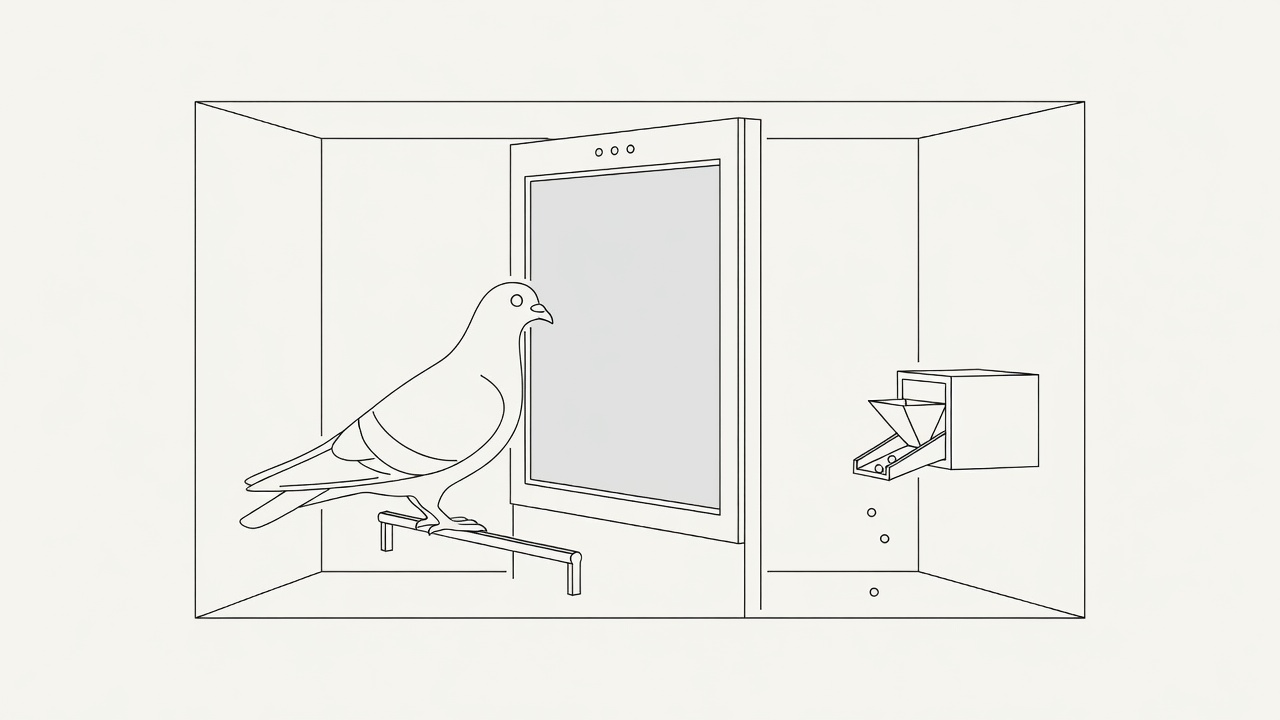
In landmark trials conducted by researchers like Richard Herrnstein and later replicated in modern avian cognition labs, pigeons demonstrated the ability to sort hundreds of photographs containing complex scenes into categories such as "human present" vs "human absent," "trees," and "water bodies." They did not merely memorize specific slides; when shown novel photographs they had never seen, they categorized them with over 80% accuracy.
Individual Face Recognition
Field experiments in Parisian parks showed that wild urban pigeons reliably recognize individual humans across repeated visits, regardless of whether the experimenters swapped clothing coats. A person who previously chased the flock was actively avoided, while a neutral observer was approached without hesitation.
Cognitive Ethology • Human Discrimination
Orthographic Word Processing
In a 2016 study published in PNAS, pigeons were trained to distinguish real four-letter English words from non-words (such as 'VERY' vs 'VREY'). The birds learned vocabularies of between 26 and 58 words, detecting letter positional shifts with competence mirroring that of baboons and early human readers.
PNAS 2016 • Statistical Language Processing
Numerical Sequence Competence
Avian neurobiologists at the University of Otago discovered that pigeons presented with sets of 1, 2, and 3 geometric shapes could independently deduce an ascending ordinal rule. When later introduced to novel sets containing 4 to 9 items, they spontaneously ranked them from lowest to highest quantity.
Comparative Psychology • Numerical Order
Self-Correction and Learning Latency
Unlike instinctual reflex species, urban pigeons exhibit cognitive flexibility. When a food reward sequence shifts from fixed-interval to variable-ratio, pigeons adjust their pecking cadence within four to six trials, demonstrating dynamic assessment of environmental yield.
Operant Dynamics • Reward Economics
How Avian Brains Outperform Their Size
Mammalian brains use layered cerebral cortex structures, while avian brains organize neurons into dense cellular nuclei within the pallium. Rock doves pack up to six times more neurons per cubic millimeter than typical rodents, shortening synaptic transmission distances and enabling swift reaction times crucial for evasive flight through city canyons.
When you observe a street pigeon tilting its head near your feet, it is not wandering aimlessly; it is running high-frequency visual discrimination algorithms honed over millions of years of foraging ecology.